
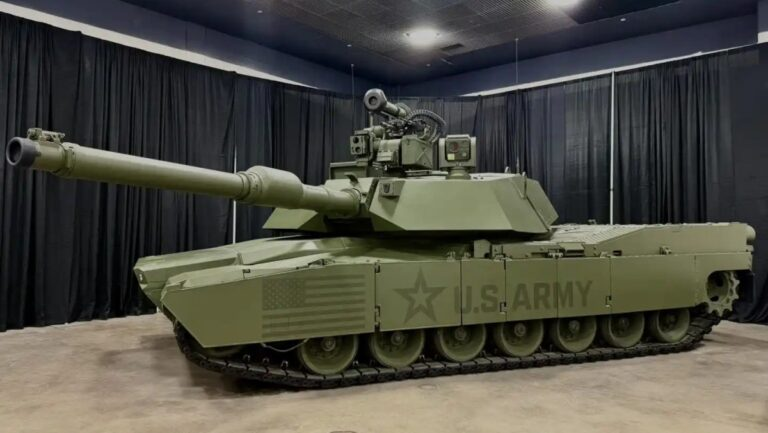
The Army is rolling out four prototypes of its M1A1 Abrams replacement to a platoon this summer — five years earlier than the service initially planned, Army Chief of Staff Gen. Randy George said.
It’s not that the tanks will be fully ready that much sooner, but the service — in line with a broader Pentagon push — doesn’t want to wait until every single requirement is met before allowing soldiers to field-test the equipment, George said. That way, soldiers can test different hardware and software components to determine what works best.
“When a vendor comes and says, ‘Hey, I’ve got something that’s better for active protection, there’s a better engine, there’s a lighter transmission to meet those specs.’ [Soldiers] could, you know, plug in and play in that,” George told reporters at the Detroit auto show this week, where the tank was unveiled for the first time.
“How the previous system was built was, ‘Don’t do anything until you’ve wrung every possible risk out,’” he added. “I do think we have to take a different approach … otherwise it’s 2031 and there’s no reason to do that.” That year, 2031, was the original target date for prototypes to reach soldiers.
Apart from the new testing approach, Chief Technology Officer Alex Miller told Breaking Defense the Army also was able to move up the M1E3 timeline thanks to a new acquisition model where the service chose a “teams of teams” approach — a model in which there’s not one lead on the initiative, but multiple vendors working together, with most of the vendors being non-traditional, commercial suppliers.
“Historically in the past, if we wanted something, we would go to a prime vendor, [and] everything below that would be a black box. They had no incentive to innovate. They had no incentive to transform or sort of think on their own,” Miller said in a recent interview.
“If we’re going to use commercial mindsets, and we’re going to use commercial best practices, and we’re going to get some of these non-traditionals that have major roles in the commercial space, we expect there to be a cycle of changes and updates over time that we can take advantage of,” he added.
Col. Ryan Howell, the M1E3’s project manager, said that this approach would also allow the Army to ensure it’s always getting top-of-the-line equipment.
“We haven’t had an industry yet, small or large, that says I cannot conform to standards that already exist in the marketplace for everything you see on this floor,” Howell told reporters at the auto show. “That’s the difference. I’m not handing them a [military] standard. I’m simply asking them, ‘What are you used to? What can you do?’”
George said that there are more than 10 companies involved in the making of the new tank. Though he didn’t reveal all of them, he said the engine is made by Caterpillar, SAPA makes the transmission, Recaro makes the seats and General Dynamics used the existing Abrams model to develop the vehicle’s exterior. Miller added that Roush, an American performance car company, played a large role in the development of the entire vehicle including the cockpit, American Rheinmetall helped with the lightweight track features and Moog created the slip ring.
As for brains, the new tank is designed to be software-defined and designed to have an open systems architecture, which allows the tank to continuously receive updates and allows soldiers to plug and play with different kinds of software, Miller said. This also means soldiers operating the tank can share information locally to platoons and a company commander.
“Now Col. Howell and the acquisition team can update our tank in days and weeks on the software side, rather than us taking a year. So the same way that your iPhone updates every couple months, or your Android updates every couple months, we can now update our main battle tank,” Miller said.
Other new features of the service’s next-gen tank include a significantly lighter design, though Howell’s team did not respond to a follow-up question about how much the tank would weigh. The tank also has a hybrid-electric engine that reduces its fuel requirements by 50 percent, George said. He acknowledged that because of this it doesn’t have a fast quarter mile time, but “it can knock out a target at a quarter mile in about a tenth of a second.”
In regards to when the tank will be fully operational and fielded across the service, Brent Ingraham, the Army’s acquisition czar, told reporters that the service has a “little more” work to do to “figure out the exact timeline.” But George said this could happen “very quickly.”